
The Fork in the Road: The Rules, Part 1

Hank wrote in a comment (edited for typos and to expand abbreviations),

As you know, Jay, many of the articles here have been written in an attempt to point out the inconsistencies of “conservative” brethren who do “draw lines” (set boundaries) in terms of what other Christians believe, how they organize themselves, and in what ways they worship. Personally, I became involved in these discussions (blogs) after learning of bro. Todd Deaver’s book “Facing Our Failure.” For as already mentioned, while he did a fine job in pointing out said inconsistencies of brethren who do “draw lines of fellowship,” what he fails to see himself is that he (and everybody else), only has three options:

1. Be just like the conservatives you so regularly take to task. In other words, go ahead and reveal where your lines clearly are in every case (female elders, motocycle blessings services, Catholics, Mormons, Jehovah’s Witnesses, practicing homosexual church leaders, whatever). And then explain how you know the line is actually where you suggest it is in every case. And not by merely giving some subjective guidelines, but actual examples of beliefs and/or practices that are sinful to God. But then, you too would be just as inconsistent as the brethen you oppose and would be be forced to “face your own failure.”

2. Maintain the apparent progressive approach. In other words, refuse to ever actually say that to believe and /or practice “thus and such” (or, Catholicism, Mormonism, Jehovah’s Witnesses, etc., is against the will of God and therefore sinful). In essence, accept, embrace, and tolerate virtually every conceiveable false belief and/or practice. (So long as the people believing and/or practicing the sin honestly believe that they are pleasing God).

3. Place yourself somewhere betwixt the two. In other words, admit that a actual and specific belief and/or practice is contrary to the revealed will of God, but not pretend to know exactly how God will handle (judge) those who believe and/or practice the sin. Be willing to say you are not sure sometimes whether a certain person, or church has actually “gone too far” (crossed the line) in terms of wehther or not they can continue believing and/or prcaticing the thing and still be considered by God to be “walking in the light” (and saved). Of course, this position will end up having you encourage people to “play it safe” in many areas. The very thing progressives apparently hate to suggest. Continue reading

Posted in Fork in the Road, Uncategorized | Tagged | 34 Comments

Dialogue

During the last few weeks, I’ve invited Wayne Jackson, who posts at the popular Christian Courier website, to come over here to discuss the Regulative Principle. He never responded.

Then about two weeks ago, I invited the speakers at the “Profiles in Apostasy Lectures #1” to post over here to discuss what causes a Christian to become an apostate. I also sent Dub McClish, one of the speakers and the editor of The Gospel Journal, an invitation via Facebook to engage in the same dialogue. I’ve received no response. Continue reading

Posted in Uncategorized | Tagged | 6 Comments

Sunday Sites: Ed Stetzer, The Lifeway Research Blog

Ed Stetzer is a popular author, speaker, researcher, and consultant. He has planted, revitalized, and pastored churches.  He has trained pastors and church planters on five continents.

He is Visiting Professor of Research and Missiology at Trinity Evangelical Divinity School and Visiting Research Professor at Southeastern Baptist Theological Seminary. He also serves on the Church Services Team at the Southern Baptist Church’s International Mission Board.

Ed’s primary role is President of LifeWay Research and LifeWay’s Missiologist in Residence.

The reason you want his blog in your RSS reader is because you’ll always be the first kid on your block to know the latest in church and missions research. This guy knows church growth and missions both as an academic and a practitioner.

Always practical, interesting, and spiritual. For a sample, check out this recent post on the American Congregations Survey.

Posted in Bible Study Resources, Uncategorized | Tagged | Comments Off on Sunday Sites: Ed Stetzer, The Lifeway Research Blog

The Lord’s Supper: Reaching Some Conclusions, Part 4

Getting creative

In Come to the Table: Revisioning the Lord’s Supper John Mark Hicks suggests several possible approaches. He notes that there are several practical barriers. For example, most congregations simply don’t have room in their auditoriums, and most auditoriums have pews bolted to the floor.This forces us to be creative if we want to occasionally recapture the original feel and meaning of the Lord’s Supper.
I’ll focus on just a few ideas (some mine, some his, some a mixture), and I’ll leave the readers to buy and read the book for the rest.

* For larger churches, the natural solution is to go truly First Century. Break up into small groups and break bread from house to house. Most larger churches already have small groups. Just suggest that they (1) eat a meal, (2) envision Jesus eating with them, and (3) serve freshly baked, unleavened bread and wine (or Welch’s) as part of the meal, remembering and proclaiming Jesus as they do so. Continue reading

Posted in Lord's Supper, Uncategorized | Tagged | 5 Comments

Election: John 6:44 and the Passover, Part 3

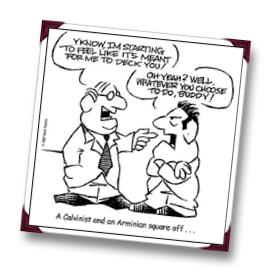
calvin-armJohn 12:32

But there’s more to it. You see, Jesus wasn’t trying to prove or disprove Calvin. He was speaking about something else entirely. To see it, we next return to —

(John 12:32)  “But I, when I am lifted up from the earth, will draw all men to myself.”

— the drawing is for all men.

This sounds like a universalist passage to many — and indeed, read literally, if “draw” means save — it sure sounds universal. But, again, Jesus wasn’t speaking to Reformation topics. He was addressing God’s redemptive mission. The point is that God will no longer only draw Israel, as in the Exodus, but he will draw all nations, in fulfillment of his covenant with Abraham. Continue reading

Posted in Election, Uncategorized | Tagged | 3 Comments

The Cruciform God: Colt McCoy, For Example

Regular readers know that I’m a big Alabama football fan. That doesn’t mean I don’t respect and appreciate other teams, including even Texas. I mean, who’d you rather beat than a team you respect?

Here are two videos from Colt McCoy that demonstrate, I believe, some of what self-emptying (kenosis) means —

You might also check out this video from the Oak Hills Church. My blogging software doesn’t let me embed this one.

Posted in Cruciform God, Uncategorized | Tagged | 5 Comments

The Cruciform God: Introduction and Chapter One, The Self-Emptying God, Part 3

We’re continuing our study of Michael J. Gorman’s Inhabiting the Cruciform God.

Husbands and wives

I need to mention another example of the importance of this understanding of the nature of God. It’s has to do with marriage and the role of women.

(Eph 4:24 ESV)  and to put on the new self, created to be like God in true righteousness and holiness.

(Eph 5:1 ESV) Therefore be imitators of God, as beloved children.

The theme of the concluding sections of Ephesians is that we’ve been created (re-created, really) so that we can be like God. Therefore, the following instructions must be understood as lessons on how to be like God. Continue reading

Posted in Cruciform God, Uncategorized | Tagged | 20 Comments

An Experiment in Christian Dialogue: Rom 14:23

Angel with harpAt the-ChurchofChrist.org, John Waddey makes a classic argument —

Like Paul, faithful Christians “walk by faith, not by sight” (2 Cor. 5:7). To “walk by faith” has a unique meaning to God’s children. The apostle wrote in Romans 10:17, “So then faith cometh by hearing, and hearing by the word of God.” To do a religious thing by faith simply means that you have been authorized to do so by Holy Scripture. Later Paul reminds us that “whatsoever is not of faith is sin” (Rom. 14:23).

Our question is, can God’s church worship him today with instrumental music and do so by faith? To do so one would have to find the practice authorized in the New Testament. Such authorization would be in one of three forms: a) An approved apostolic example, b) a direct command, c) a necessary inference. In fact none of these modes of authorization can be discovered [regarding instrumental music in worship].

Is it true that Rom 14:23 makes it a sin to do “a religious thing” that hasn’t been authorized by example, command, or inference?

(Rom 14:23)  But the man who has doubts is condemned if he eats, because his eating is not from faith; and everything that does not come from faith is sin.

Notes:

1. This isn’t as easy at it might appear. Argue from context. What does “faith” mean in Rom 14:23?

2. Please, let’s just talk about the Waddey quote and Rom 14:23.

Posted in Regulative Principle, Uncategorized | Tagged | 19 Comments

Communion Meditation: The Taste of Faith

CommunionImagine that you’re walking the roads of Jerusalem in First Century Palestine. It hasn’t rained in weeks, and the roads are so dusty that when the wind picks up, you can barely breathe. It’s the spring, so the days are getting longer and the sun is getting hotter. And you’re a disciple of a rabbi whom the Romans and Jewish leaders believe ought to be kiiled.

It’s dinner time and the Passover, and you’re hungry, thirsty, and scared. Continue reading

Posted in Communion Meditations, Uncategorized | Tagged | 13 Comments

Election: John 6:44 and the Passover, Part 2

calvin-arm“Draw”

And so, we come to John 6:44.

(John 6:44)  “No one can come to me unless the Father who sent me draws him, and I will raise him up at the last day.”

Now, Jesus doesn’t suddenly change the subject from Exodus and his role as the bread of life to Calvinism. The verse may well speak to Calvinism, but if it does, it speaks from First Century Palestine in a discussion built on the original Exodus and how God is bringing a new Exodus for his people.

The “last day” is a reference to the resurrection, of course, but also a comparison of the Promised Land of the Exodus to the new heavens and new earth promised to the faithful in the Prophets. Continue reading

Posted in Election, Uncategorized | Tagged | 8 Comments