 In The Life Cycle in Congregations, Arlin J. Rothauge advises churches on how to cope with stability, decline, and death. During decline or death, we are aware that there’s a problem, but when we’re plateaued, we tend to figure that we shouldn’t mess with what brought the original growth. And yet the best time to head off is decline is when plateaued, rather than waiting until things start to go downhill.
 Stability and the Operator.
At this point in the life cycle the high level of energy and creativity recedes to make way for a growing concern for maintenance. The need for wise administration of the organization and preservation of the traditions requires the type of leader who can operate complex systems. However, “stability” becomes the first period of reshaping-in order to maintain vitality as well as continuity. Consequently, the best “operator” also will be a clever innovator.
All decline is preceded by a period of stability. We have to reach the flat, top of the curve before we begin the descending part.
There is a certain logic to the process of beginning formation over again. The probable steps are as follows:
1. Identity: “Why are, we in business? What are our assets and strengths?” Members rediscover who they are and why they exist as a congregation in this place and time.
2. Vision: “Where do we want to go?” Members reaffirm their obligation to become more faithful to their congregation as it could be in the future.
3. Strategy: “How will we get the job done?” Leaders reequip members and themselves with whatever it will take to reach for their new future. They plot and prepare for the step-by-step progress that will make the dream come true.
4. Experimental Action: “What are we ready to try?” Members choose the highest priority and closest possibility in their plan and commit themselves to a metamorphosis, one small step at a time until the dream turns into a revised vision or a full reality.
5. Reflection: Finally, “How is it going, and what’s next? Where do we adjust our course?” The congregation should always pause for thanksgiving, absolution, offertory, and celebration. The insights and prayers of the membership guide the evaluation of how they are doing.
Stability is not growth. Therefore, to re-initiate growth, you must begin anew. For a denomination, this means becoming a new movement. Rather than seeking to preserve what’s been accomplished — a defensive strategy — the question should be: what needs to be achieved now?

Decline and the Healer. When a group falls into decline, its sense of security gives way to a grief process. The behavior in the group reflects what happens in times of significant loss. Members might try to deny the difficulty, bargain with fate by reviving the past, focus too much anger on themselves, their leader, or outsiders as a cause for the hard times, and finally slip into depression, passivity, and resignation. In this grief reaction, the leader brings healing by understanding, absolution, encouragement, and innovation. The healer, like the operator, completes his or her role by bringing the group back to a level of higher energy and creativity through new vision and the birth of new directions A grief process is healthy unless some pathological extreme emerges. The healer brings balance and discipline to the grief work.
The Churches of Christ are in a time of decline. Mourning for what’s been lost is healthy — so long as mourning doesn’t lead to a fixation on the past. The cure is the same as for stability. It’s just that it’s harder to change in a period of decline because for many, change means defeat.
In the recent history of the Churches, it’s easy to find examples of denial, efforts to revive the past, anger directed at ourselves, our leaders, and outsiders — and even depression, passivity, and resignation. There are plenty among us who feel the situation cannot be changed and we should resign ourselves to the death of the Churches.
Second, decline and redevelopment entail, in addition to redefinition, the restatement of strategy and vision. More disturbing questions point the way forward when another frame of reference is needed. The congregation asks, for example: Why do we have this building and these traditions? Why do we have a pastor? Where is our neighborhood? Are we the same church that our founders envisioned?
In denominational terms, we ask: Why do we have these traditions? Why do we have the denominational leadership we have? Must we bend to the will of the editors? What is the field in which God has equipped us to harvest? Are we still the Movement the founders envisioned? Is their vision still relevant today? Do we need a new vision? How do we recast a 19th Century vision in 21st Century terms?
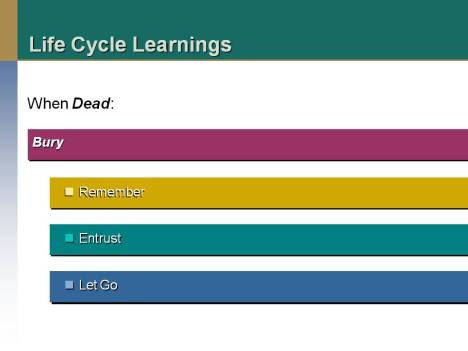
Death and the “Parent.” When the group moves from the critical phase to the survival syndrome, the leader finds the members exhausted with grief and immobilized by a lack of self-confidence. It may be necessary for the leader to become temporarily a “parent,” allowing extradependency upon their strength and optimism. The “parent” teaches the group how to “talk” again, how to “walk” again, and how to “grow up” into being a different group. Out of the intense care by the parent, a rebirth may come from the terminal situation. If not, the remaining members at least find the capacity to celebrate their past and accept the closure of the life cycle for their congregation.
I know that many have already declared the Churches of Christ, and certainly some of our congregations have died and others are on their death beds. But it’s easy to see signs of great vitality as well. It’s not quite time for the death certificate.
On the other hand, to come a vibrant denomination that’s effectively serving in God’s kingom, the denomination has to die — so that God can resurrect it. We can’t let nostalgia and tradition hold us back. Rather, as we must all individually die so that we can be raised in new life in the Kingdom, so must the Churches of Christ.
Death, however, doesn’t mean ceasing to exist. Death means submitting to God’s re-creating hand and letting him reshape us into a new creation.
(2 Cor 5:17) Therefore, if anyone is in Christ, he is a new creation; the old has gone, the new has come!
(Col 3:3) For you died, and your life is now hidden with Christ in God.
(Rom 6:9-11) For we know that since Christ was raised from the dead, he cannot die again; death no longer has mastery over him. 10 The death he died, he died to sin once for all; but the life he lives, he lives to God. 11 In the same way, count yourselves dead to sin but alive to God in Christ Jesus.


 I miss football already. I mean, there are no more college football games to look forward to until August! (Is this an addiction? Do I need professional help?)
 Well, the mail came the other day, and I just got my copy of the brochure for the Pepperdine lecturships. And lo and behold there was my preacher, Shon Smith, listed at the keynote speaker!

